







Amid growing concerns over federal misinformation and the circumstances surrounding the death of Alex Pretti, the Democratic Party’s need for a check on the Trump Administration is more pressing than ever. The most effective opportunity to hold it accountable is the 2026 midterms, as gaining control of either chamber would enable Democrats to more effectively check the Trump Administration’s actions. This is especially true for the Senate; there, however, the fight will be an uphill battle given Democrats’ need to flip four seats on a difficult electoral map.
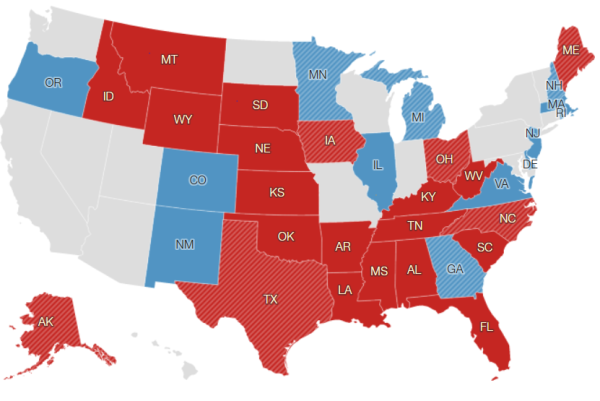
To maximize their electoral success and thus their political power, Democrats need to be strategic about the candidates they are supporting. They need to carefully consider who the party nominates, donates to, or, in some states, whether they should even run a Democrat in the first place.
Democrats usually do a solid job at candidate recruitment, and this has been the case in 2026, with several top-tier candidates running, namely former Governor Roy Cooper in North Carolina, former Senator Sherrod Brown in Ohio, and former Representative Mary Peltola in Alaska. However, there are a few races where the party risks undermining its chances by nominating the wrong candidate, and every seat matters for a party with a slim path to retaking the majority.
Perhaps the most notable of these races is the Texas Senate Democratic primary, where Representative Jasmine Crockett, a partisan liberal firebrand, is facing off against James Talarico, a state representative. In an interview with CNN, Crockett said, “I don’t know that we’ll necessarily convert all of Trump’s supporters. That’s not our goal… We don’t need to.” Unfortunately for Crockett, her years-long mentality of catering exclusively to the Democratic base through constant anti-Trump/anti-MAGA messaging is not a viable general election strategy in a state Trump carried by double digits.
Nominating Crockett is a gift to Republicans (who actively goaded her into running), and though it is an uphill battle to flip Texas, that does not mean that Democrats should not at least try with the strongest possible candidate. Additionally, running a strong race could have effects elsewhere; this was seen in 2022, when a closer-than-expected contest for ruby red Ohio’s Senate seat diverted resources from competitive races such as Pennsylvania, a state Democrats ultimately flipped.

In some states, Democrats are better off not even running a Democrat. Case in point: the 2024 Nebraska Senate race, where independent candidate Dan Osborn ran a competitive race in a state which Trump carried by over 20 points. According to the election forecasting organization SplitTicket’s wins-above-replacement (WAR) database, Osborn’s WAR score was D+17.7. In other words, Osborn outperformed a generic Democrat by nearly 18 points. Given the degree to which partisan polarization and the party’s leftward positioning have weakened the Democratic brand in certain states, an independent candidate amenable to the party’s agenda may be better positioned to win.
While independents lag behind Democrats with nonwhite voters, rendering this strategy unwise in states like Texas and Florida, studies also show that independents do better with white voters. Two predominantly white states, Nebraska and Montana, currently have two strong independents running for the Senate this year: Osborn and former University of Montana President Seth Bodnar, respectively.
There are rumblings from Democrats in both states, but the harsh reality is that even the best possible Democrat cannot win: in 2024, three-term incumbent Senator Jon Tester, a popular figure in Montana, lost his reelection bid. Tester himself recognizes this reality and is backing Bodnar. Either tacitly or explicitly supporting a strong independent candidate may represent the most strategically sound path forward.