




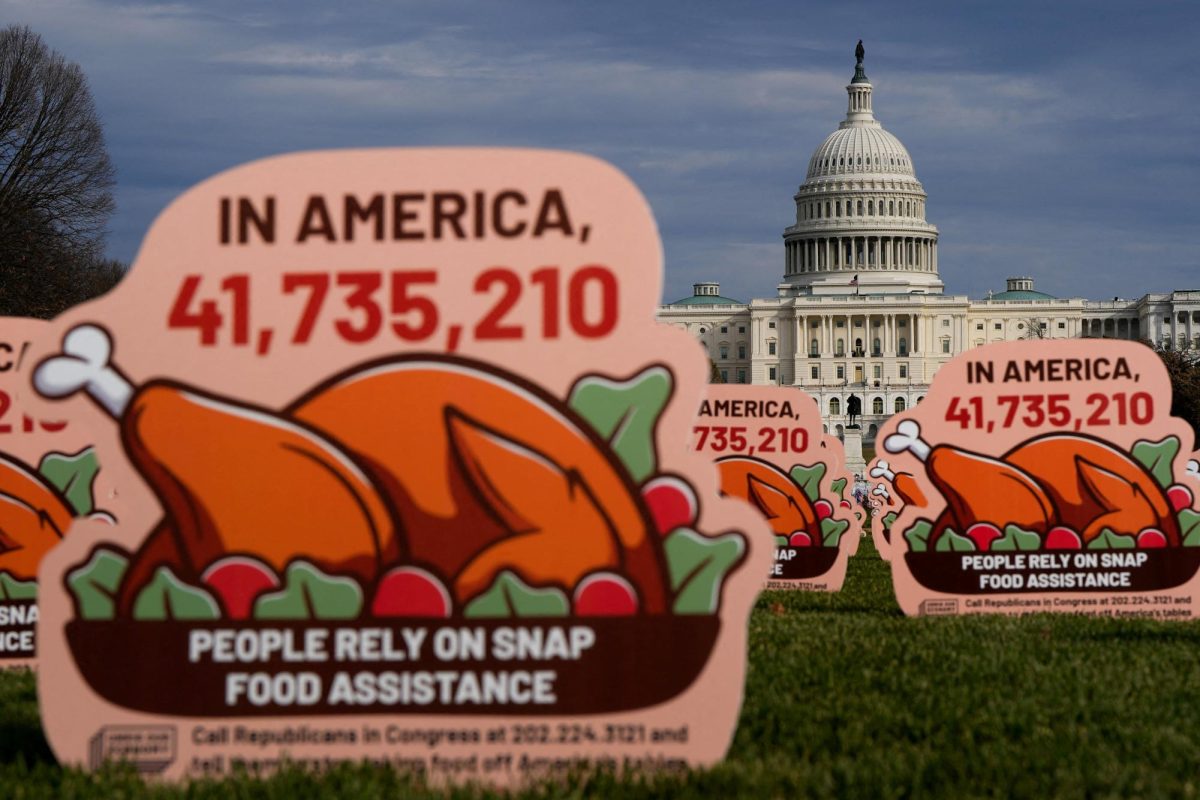
One of President Donald Trump’s most common political epithets for Democrats is the “radical left.” He claims that radical left “lunatics” and “scum” are responsible for a range of issues, including increased political violence and comically long TSA lines in airports. The White House even created a “Left-wing lunacy” page on its website to target reporters and rectify their alleged offenses against “The Truth.”
Democrats should obviously reject any of the more cutting rhetoric that they are lunatics or scum. But to me, the term “radical left” seems to be distressingly ironic.
To this, I say: if only. If only the left were radical.
MAGA’s rise in the United States has caused a massive rightward shift on the political spectrum: what was right has been pushed to far-right; what was left, to center.
Within the Democratic Party, centrism is in full force. Take Kamala Harris, whose campaign promises were regurgitations of corporate interests. Take Gavin Newsom, who plans to squash billionaire tax proposals in California. And take Kathy Hochul, who has sidestepped taxing the rich by claiming that it would drive wealth out of the state.
These three headliners of the Democratic Party reflect a growing reliance on centrist politics within the party and on the left more generally. In October 2025, The New York Times editorial board published an article titled “The Partisans Are Wrong: Moving to the Center Is the Way to Win,” arguing that moderation has been a key factor in propelling candidates to victory in recent elections. They cited multiple Democrats who, because of their moderate politics, won elections. These include Sen. Ruben Gallego, D-Ariz., and Rep. Vicente Gonzalez, D-Texas, who have advocated for stronger immigration laws at the border.
The board further argued that “moving to the center would enable Democrats to confront [Trump] more aggressively and effectively because voters would see them as credible.” In contrast, progressive messaging would be ineffective because the people who are inspired by it “account for a small share of the country—disproportionately college-educated and white.”
This is not what Democrats should do. First, the outcome of the 2024 presidential election proved that running a centrist candidate was a fatal mistake: By many accounts, it was the first time Democrats received a higher share of votes from high-compared to low-income Americans. In fact, the only bloc Harris saw gains in was white, college-educated voters.
After their loss, the Democratic Party was in crisis, flailing and floundering in offices across the country. Their identity seemed to be incoherent, obscured by influence from billionaire donors and by empty rhetoric around shallow cultural issues.
One of the main activities among political commentators became analyzing and diagnosing the Democratic Party: Where did they go wrong? Why don’t people like them? What do they need to do now? Such were the common themes amongst countless media pieces. Many concluded that the Democrats are splintered, directionless, and unable to articulate where they are going or how they would get there.
This brings me to my second point: there is something fundamentally wrong with the Democrats, but it is not an issue that can be solved with economic populism or intricate plans to build affordable housing. The problem is not one of policy, but rather one of philosophy: the party needs to embrace ideology, not run away from it. If people are disenchanted with the left or struggle to define its identity, it is because nothing holds Democrats’ ideas together.
People are not galvanized by centrist policies which aim to please everyone, but satisfy no one except the wealthy. This creates a stagnant left that is resistant to fighting for significant grassroots social change, largely because it does not know what it is fighting for. Democrats’ balancing act between maintaining donor support and winning back the working class prevents them from articulating a clear, unifying goal.
The crisis of the Democratic Party is ultimately one of voter disillusionment. An issue of this magnitude will not be solved with calls for moderation; it requires a radical approach.
What the Democratic Party needs is a philosophy to connect its ideas. Policies on affordable housing, raising taxes on the wealthy and expanding Social Security and Medicare programs are all positive, but they raise a deeper question: Why do we want these things? The answer, though obvious, has been largely missing from Democrats’ rhetoric: people want a better life. As Jonny Thakkar, an assistant professor of political science at Swarthmore College, claims, this absence of a clear vision of “the good life” explains the Democrats’ failure.
In his article “Beyond Equality,” Thakkar argues that “If the left is to pull people toward it, it needs to orient itself around a worldview that provides positive, eros-inducing energy.” The way to do this, he says, “is to offer a vision of the good life that goes beyond the pursuit of equality.”
In defining this idea of a good life, Thakkar draws on Marxist thought, specifically Marx’s premise that capitalism’s prioritization of productivity comes at the cost of human fulfillment, estranging workers from their labor and from one another. Under this framework, moderation, because it involves a deference to the status quo, preserves existing systems responsible for that estrangement. Is it then possible that a “good life” like the one Thakkar posits requires not neutrality but radical philosophy?
Democrats would do well to sit with that question. The party often does things for the numbers, endorsing certain policies simply to gain favor with specific voters. But Democrats need to offer an explanation of that why question—one that goes beyond appealing to these voting blocs. For example, if the party wants to tax the rich, Democratic message should emphasize not only how the tax money could be used to fund more public spaces or reduce the cost of living, but also on how these different benefits are united under the idea of pursuing a good life for all.
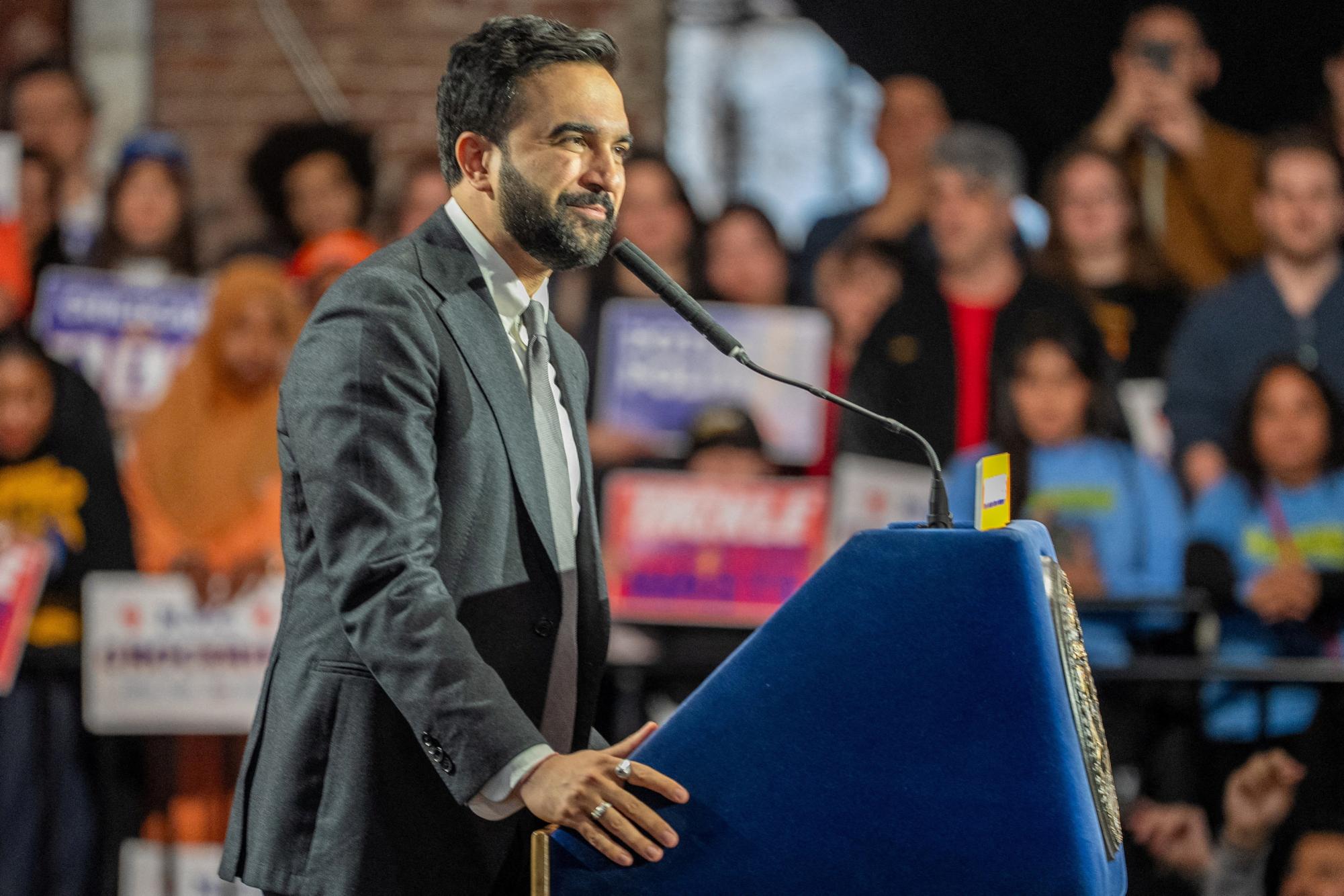
New York City Mayor Zohran Mamdani, a democratic socialist, has done a good job of this. Throughout his mayoral campaign last year, he effectively communicated the connection between his policies, such as a rent freeze and city-owned grocery stores, and an underlying idea that they would lead to a better life for all New Yorkers.
His rejection of political neutrality in favor of a platform unified under the philosophy of the good life excited voters, helping power his win over Andrew Cuomo, the centrist former governor. Trump was quick to refer to Mamdani as “radical” throughout his campaign, and he should be: the Democratic Party needs that radicalism, grounded in “the good life.”